via intac.net
Don’t Mind Your Language…
By Stephen Fry
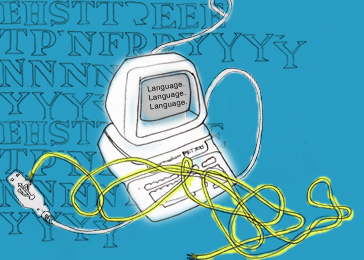
November 4th, 2008Language. Language, language, language. In the end it all comes down to language. I write to you today on this subject as a way of welcoming you to www.stephenfry.com 2.0 and because, well, it’s a subject worth thinking about at any time and because fewer things interest me quite so much.
Image: Nicole Stewart for SamFryThere are so many questions and issues jostling, tumbling and colliding in my mind that I can barely list them. Is language the father of thought? There’s one. Somebody once said, “How can I tell you what I think until I’ve heard what I’m going to say?” Is language being degraded, is it not what it was? Is there a right way to express yourself and a wrong? Grammar, does that exist, or is it a pedantic imposition, a kind of unnatural mixture of strangulation and straightening, like pleaching, pollarding and training pear-trees against a wall? Can we translate from one tongue into another without irreparable loss? And many, many more.
“Language is the universal whore that I must make into a virgin,” wrote Karl Kraus or somebody so like him that it makes no odds. One of my favourite remarks. T. S. Eliot said much the same thing in a different way: “to purify the dialect of the tribe”. But is there a “higher language”, a purer language, a proper language, a right language? Is language a whore, used, bruised and abused by every john in the street … is the idea of purifying the dialect of the tribe a poetic ideal or nonsensical snobbery?
I suppose we should remind ourselves of the old distinction made by the structuralists and structural linguists. I wrote a sketch about this years and years ago and if you know it, you’ll have to forgive the similarities between what I found to be a source of humour and what I am now apparently taking seriously. Actually the one doesn’t cancel out or refute the other. We can make fun of this kind of language about language and we can value it too. So bearing in mind that I am fully aware that I sound like the worst kind of pseudo-intellectual twazzock, let’s look at that distinction. There is language, the thing itself, the idea of language. And then there is this or that example of language in praxis, in use. There is Chess and there is this or that game of chess. The Game of Chess and that game of chess going on over there. There is language, the human capacity – ‘competence’ as Chomsky calls it, The Game of Language – and there is utterance, the actual instance of its use – this sentence for example. Of course aside from both of these, there is the local tongue, English, French, Cantonese, Basque, whatever.
The two for consideration however as those once fashionable Frenchies designated them are Langue, language as an idea, and parole, language as utterance. In this instance of parole I am using not only English, but my own brand of English, an English English salted, spiced, pickled, seasoned, braised and plated up to you bearing all the flavours of my class, gender, education and nature, discourses as you might call them. I am in some sort a language professional I suppose, in as much as I write and broadcast, I linguify for a living you might say. Nonetheless, I can no more change my language and the sum of its discourses than I can add a cubit to my height or, sadly it seems, take a pound from my weight. Well, perhaps that’s going a little far. I can attempt to disguise my language, I can dress it up into even more elaborate and grandiose orotundity, prolixity and self-consciousness, Will Self-consciousness you might say, or I could dress it down into something stripped. Stark. Bare. Simple. It would be hard to dress it down into something raggedly demotic without it being a patronising pastiche of a street argot to which I quite evidently have no access and in whose mazy slang avenues I would soon get lost, innit? In a sense I am typecast linguistically and although I can for fun try on all kinds of brogues and dialect clothes, my voice, my style, my language is as distinctive as my fingerprints.
My language (as the sum of my discourses, as linguistic strata that betray my history, as geology or archaeology betrays history) is my language and it is a piece of who I am, perhaps even the defining piece. In my case it is in part a classical ruin, inherited boulders of Tacitus and Cicero bleaching in the sun along with grass-overrun elements of Thucydides and Aeschylus … not because I was a classical scholar, but because I was taught by classical scholars and grew up on poets, dramatists and novelists who knew the classics as intimately as most people of my generation know the Beatles and the Stones. Without knowing it therefore, heroic Ciceronian clausulae and elaborate Tacitan litotes can always be found in the English of people like me. In part classical ruin, then, my language in particular has also mixed in it elements of my three Ws, my particular world wide web, my w.w.w, Wodehouse, Waugh and Wilde, three writers who greatly excited my imagination and stimulated my language glands like no other. I would add Vivian Stanshall of the Bonzo Dog Doo Dah Band, Peter Cook and Alan Bennett as others of whom I am consciously aware. But the language of British movies, classic novels, sixties and seventies broadcasters like Malcolm Muggeridge, James Cameron, Alistair Cooke, John Ebden, Anthony Quinton, Robert Robinson, they all played their part in informing my spoken and written utterance too, not to mention the elemental styles which in turn informed their language. As Henry Higgins reminds us in Pygmalion, English is for all of us the language of Shakespeare, Milton and the Bible. We unconsciously use the tropes, tricks and figures of our great writers, just as we might without knowing it use a tierce de Picardie or a diminished seventh when humming in the shower. And to our native English today we have added the language of American sitcom and drama, American movies and Australian soap operas.
I’ve used this analogy before, but I’ll use it again. Think of London. Some of its outline was determined by the Romans who conquered it two thousand years ago, since then atop the ruins of the Roman, Saxon, Dark Age and Norman London was constructed a medieval city of winding streets, jostling half-timbered mansions and soaring stone cathedrals and churches. Then came, after the Tudor and Jacobean palaces and halls and after the restoration a period of renewed classical elements, the squares and avenues of Georgian and Regency London, elegant, spacious and harmonious. The Victorians brought long suburban streets, warehouses, libraries, schools, town halls and railway stations and in the twentieth century arrived a new architecture, office towers, corporate headquarters, airports, housing projects in glass and concrete, American and European statements of self conscious modernity, statehood, brutalism, socialism, capitalism and democracy. It isn’t I think, too much of a strain to see the history of our language in similar terms. A long sticky flypaper onto which at varying times of their importance the church, royalty, aristocracy, industry, commerce and international entertainment have accreted themselves. Saxon and Roman elements overlaid with the Norman French and Chaucerian and Church medieval English. A great renaissance of Shakespeare, the Bible of King James, Milton and Dryden leading into the classical English of Johnson and Pope. The Victorian English of industry, Dickens and music hall giving way to the English of the twentieth century, all the way through the arrival of radio and cinema, the political language of fascism, communism, socialism and finance, the Americanisms, the street talk, the rock and roll, the corporate speak, the computer jargon … and here we are. Glass and concrete sentences right next to half-timbered Elizabethan phrases, a Starbucks of an utterance dwelling in an expression that once belonged to a Victorian banker, an Apple Store of an accent in a converted Georgian merchant’s lingo. You get the point. Whether or not we are aware of the difference between a transitive verb and a preposition, a verb and a vowel, we are willy-nilly, heirs to Marlowe and Swift, just as that new Waitrose is a descendant (albeit a bastard one) of the Parthenon. Bear in mind that phrase willy-nilly, by the way – I shall return to it later. For the meantime, seal it in a baggie and stash it in your hoodie. Or fold it in scented tissue and lay it tenderly in your hope chest, according to taste.
I’ve mentioned those French intellectuals the structuralists: one of their number, perhaps the best known, Roland Barthes, liked to use two words jouissance and plaisir. Le plaisir du texte. The pleasure of the text. Those who think structuralism spelt or spelled death to conscious art and such bourgeois comforts as style, accomplishment and enjoyment might be surprised that the pleasure of the text, the jouissance, the juicy joy of language, was important to Roland and his followers. Only to a dullard is language a means of communication and nothing more. It would be like saying sex is a means of reproduction and no more and food a means of fuelling and no more. In life you have to explain wine. You have to explain cheese. You have to explain love. You can’t, but you have to try, or if not try you have, surely, to be aware of the astonishing fact of them. We would never notice if the fat and protein rich food with which cows, ewes and nanny goats suckled their young could not be converted to another, firmer foodstuff that went well with crackers and grapes. We wouldn’t go about the place moaning that sheep’s milk was only of any use to lambs, any more than I have ever heard anyone wonder why pig’s milk doesn’t make a good yoghurt. In fact if you suggest drinking pig’s milk or horse’s milk, people look askance and go “yeurgh!” as if it’s the oddest suggestion they’ve ever heard. We take what nature and custom have led us to accept. As Eddie Izzard pointed out, it’s odd that bees make honey: ‘after all,’ he said, ‘earwigs don’t make chutney.’ And take that arbitrary fruit, the grape: suppose grapes didn’t uniquely transmogrify themselves, without the addition of sugar, into a drink of almost infinite complexity? We wouldn’t wonder at the lack of such a thing as wine in the world, any more than we wonder that raspberry wine (despite the deliciousness of raspberries as fruit) can’t, in the proper sense, exist or speculate on why the eggs of carp aren’t as good to eat as the eggs of sturgeon. But every now and again we should surely celebrate the fact that caviar is so fine, that the grape offers itself up so uniquely, that milk products of three or four species have such versatile by-products for us, that the grain of some grasses can be transformed into bread, that the berry, pod or leaf of this plant or that plant can give us chocolate, coffee or tea, and that while the fuzz of this plant can’t go to make a shirt, the fuzz of that unique one canand the thread of this insect can go to make a tie, while the equally impressive thread, in nature, of that other insect can’t be spun into the simplest handkerchief. Is it weird that silkworms exist or is it weird that only the silkworm will do when it comes to silk and only the cotton plant when it comes to cotton? To put it again, in an accidental line of decasyllabic verse, ‘none would be missed if they didn’t exist’. And if language didn’t elicit pleasure, if it didn’t have its music, its juiciness or jouissance would we notice, or would always be destined to find pleasure in it because that’s a thing we humans can do? Out of the way we move we can make dance, out of the way we speak we can make poetry and oratory and comedy and all kinds of verbal enchantments. Cheese is real, and so it seems, is the pleasure of the text.
I’m veering all over the shop. We’ll return to pleasure later. Steven Pinker, the Harvard Professor who writes on psycholinguistics and the evolutionary development of language and the mind, has made quite a tidy living out of popularising what you might call Chomskian ideas. Noam Chomsky may be better known now for his penetrating critiques of American foreign policy, but he made his reputation as a pioneering linguist. His discovery (or theorem if you prefer) was that the mind comes pre-equipped for language, syntax and grammar, much as the body comes pre-equipped for growth and sexual development. A baby doesn’t have underarm hair, but it has the innate program within it which, at a certain age, usually between twelve and fourteen, will be activated to start producing hair under the arms: a parent doesn’t have to teach it, only the right and natural nutrients need to have been ingested over time so as to allow normal growth and it will just happen. So it is, argue the Chomskians, with language: each baby (given normal development) has an innate language faculty, a language instinct Pinker calls it: local differences between Chinese and English are not, according to this theory, so very profound. A parent doesn’t teach language, much as they may think they do, they just occasionally spoon-feed a bit of vocabulary: moo-cow, baa-lamb, colours and so on, usually – you’ll never hear a parent say “and these are called ‘stairs’ or ‘to wash’ means ‘to clean with water’” – the child absorbs that kind of vocabulary without teaching. The really clever bits, the structure and lexical rules … these no parent can teach because it’s highly unlikely they will even be aware of them. You do not say to an English child: “the aorist of ‘to see’ is ‘saw’ the perfect is ‘have seen’”. You don’t even tell them that to give a sense of the past you add ‘-ed’ to the end of the verb. ‘I play,’ ‘I played’. Many parents will not know what a verb is, nor will they need to, any more than you need to know what an alternator is to drive to the shops or, more pertinently, any more than you need to know what a bronchial tree or alveoli are in order to breathe. This may sound obvious to us all, language as a natural, evolved innate faculty; after all, the theory has been understood and mostly accepted for forty or so years, but if you look back over the history of linguistics to beyond the time such a word even existed, over the shoulders of Saussure, Jakobson and the Brothers Grimm to the earliest philologists and language investigators, there was no obvious reason to suppose that language was innate. Or at least not innate in that way. Many believed, quite seriously, that the Biblical explanation in the story of the Tower of Babel was the true answer to the riddle of language, just as they believed in the Flood and the Creation. Others thought that there was a ‘natural’ language, a primary tongue. Some suggested that it was Latin, others, out of religiosity, that it must be Hebrew, Greek or Aramaic. They went so far, under the patronage of bishops and monarchs who took an interest in the subject, as to take foundling children by way of experiment and isolate them completely from all human congress, to give them no access to language at all while they grew up, in the hope that they would revert to some posited universal and original language, the linguistic equivalent of a chemical element or primary tissue, and thereby prove once and for all which of the world’s tongues had primacy. Of course what happened was that such children invented their own language amongst themselves, true languages with wide vocabularies and complex syntactical structures. It is a shame in a way that it would now be considered too cruel to repeat the experiments, just imagine how much would be revealed by a study of these unique languages.
Other theories touching on the nature and origins of language that have had some vogue include that of Professor Jayne’s 1976 book The Origin of Consciousness in the Breakdown of the Bicameral Mind, a fascinating and bold attempt to explain language and, more fundamentally, consciousness itself. Richard Dawkins said that it “… is one of those books that is either complete rubbish or a work of consummate genius, nothing in between.” Whatever the truth or cogency of Jayne’s central argument, it remains an elegantly written and provocative read and helps raise the issue of whether language is necessary for the subconscious mind, let alone the conscious, to exist. His theories of metaphor are especially interesting. But let’s return to pleasure before we get bogged down in bibliography.
For me, it is a cause of some upset that more Anglophones don’t enjoy language. Music is enjoyable it seems, so are dance and other, athletic forms of movement. People seem to be able to find sensual and sensuous pleasure in almost anything but words these days. Words, it seems belong to other people, anyone who expresses themselves with originality, delight and verbal freshness is more likely to be mocked, distrusted or disliked than welcomed. The free and happy use of words appears to be considered elitist or pretentious. Sadly, desperately sadly, the only people who seem to bother with language in public today bother with it in quite the wrong way. They write letters to broadcasters and newspapers in which they are rude and haughty about other people’s usage and in which they show off their own superior ‘knowledge’ of how language should be. I hate that, and I particularly hate the fact that so many of these pedants assume that I’m on their side. When asked to join in a “let’s persuade this supermarket chain to get rid of their ‘five items or less’ sign” I never join in. Yes, I am aware of the technical distinction between ‘less’ and ‘fewer’, and between ‘uninterested’ and ‘disinterested’ and ‘infer’ and ‘imply’, but none of these are of importance to me. ‘None of these are of importance,’ I wrote there, you’ll notice – the old pedantic me would have insisted on “none of them is of importance”. Well I’m glad to say I’ve outgrown that silly approach to language. Oscar Wilde, and there have been few greater and more complete lords of language in the past thousand years, once included with a manuscript he was delivering to his publishers a compliment slip in which he had scribbled the injunction: “I’ll leave you to tidy up the woulds and shoulds, wills and shalls, thats and whiches &c.” Which gives us all encouragement to feel less guilty, don’t you think?
There are all kinds of pedants around with more time to read and imitate Lynne Truss and John Humphrys than to write poems, love-letters, novels and stories it seems. They whip out their Sharpies and take away and add apostrophes from public signs, shake their heads at prepositions which end sentences and mutter at split infinitives and misspellings, but do they bubble and froth and slobber and cream with joy at language? Do they ever let the tripping of the tips of their tongues against the tops of their teeth transport them to giddy euphoric bliss? Do they ever yoke impossible words together for the sound-sex of it? Do they use language to seduce, charm, excite, please, affirm and tickle those they talk to? Do they? I doubt it. They’re too farting busy sneering at a greengrocer’s less than perfect use of the apostrophe. Well sod them to Hades. They think they’re guardians of language. They’re no more guardians of language than the Kennel Club is the guardian of dogkind.
The worst of this sorry bunch of semi-educated losers are those who seem to glory in being irritated by nouns becoming verbs. How dense and deaf to language development do you have to be? If you don’t like nouns becoming verbs, then for heaven’s sake avoid Shakespeare who made a doing-word out of a thing-word every chance he got. He TABLED the motion and CHAIRED the meeting in which nouns were made verbs. New examples from our time might take some getting used to: ‘He actioned it that day’ for instance might strike some as a verbing too far, but we have been sanctioning, envisioning, propositioning and stationing for a long time, so why not ‘action’? ‘Because it’s ugly,’ whinge the pedants. It’s only ugly because it’s new and you don’t like it. Ugly in the way Picasso, Stravinsky and Eliot were once thought ugly and before them Monet, Mahler and Baudelaire. Pedants will also claim, with what I am sure is eye-popping insincerity and shameless disingenuousness, that their fight is only for ‘clarity’. This is all very well, but there is no doubt what ‘Five items or less’ means, just as only a dolt can’t tell from the context and from the age and education of the speaker, whether ‘disinterested’ is used in the ‘proper’ sense of non-partisan, or in the ‘improper’ sense of uninterested. No, the claim to be defending language for the sake of clarity almost never, ever holds water. Nor does the idea that following grammatical rules in language demonstrates clarity of thought and intelligence of mind. Having said this, I admit that if you want to communicate well for the sake of passing an exam or job interview, then it is obvious that wildly original and excessively heterodox language could land you in the soup. I think what offends examiners and employers when confronted with extremely informal, unpunctuated and haywire language is the implication of not caring that underlies it. You slip into a suit for an interview and you dress your language up too. You can wear what you like linguistically or sartorially when you’re at home or with friends, but most people accept the need to smarten up under some circumstances – it’s only considerate. But that is an issue of fitness, of suitability, it has nothing to do with correctness. There no right language or wrong language any more than are right or wrong clothes. Context, convention and circumstance are all.
I don’t deny that a small part of me still clings to a ghastly Radio 4/newspaper-letter-writer reader pedantry, but I fight against it in much the same way I try to fight against my gluttony, anger, selfishness and other vices. I must confess, for example, that I find it hard not to wince when someone aspirates the word ‘aitch’. Haitch Eye Vee, you hear all the time now, for HIV. It’s pretty much nails on the blackboard to me, as is the use of the word ‘yourself’ or ‘myself’ when all that is meant is ‘you’ or ‘me’ but I daresay myself’s accent and manner is nails on the blackboard to yourself or to others too, in itself’s own way. Myself also mourns, sometimes, the death of that phrase I bade you upon pain of slapping to remember some time back, ‘willy-nilly’, do you remember? Fold it in your hope chest, I urged, or seal it in a baggie. Well you can take it out now. Willy-nilly. What happened there? Willy-nilly is now used, it seems, to mean ‘all over the place’; its original meaning of ‘whether you like it or not’ (in other words ‘willing or unwilling’) is all but forgotten. Well, that’s ok, I suppose. I don’t mind either that the word ‘meld’ is now being used as a kind of fusion of melt and weld, instead of in its original sense of ‘announce’. Meld has changed … that’s okay. There’s no right or wrong in language, any more than there’s right or wrong in nature. Evolution is all about restless and continuous change, mutation and variation. What was once ‘meant’ in the animal kingdom to be a nose can end up as an antenna, a tongue, eyes, a pair of lips or a blank space once evolution and the permutation of new DNA and new conditions has got to work. If the foulness of the Kennel Club mentality was operated in nature, just imagine … giraffes’ necks wouldn’t be allowed to stretch, camels wouldn’t get humps, such alterations would be wrong. Well it’s the same in language, there’s no right or wrong, only usage. Convention exists, of course it does, but convention is no more a register of rightness or wrongness than etiquette is, it’s just another way of saying usage: convention is a privately agreed usage rather than a publicly evolving one. Conventions alter too, like life. Things that are kept to purity of line, in the Kennel Club manner, develop all the ghastly illnesses and deformations of inbreeding and lack of vital variation. Imagine if we all spoke the same language, fabulous as it is, as Dickens? Imagine if the structure, meaning and usage of language was always the same as when Swift and Pope were alive. Superficially appealing as an idea for about five seconds, but horrifying the more you think about it.
If you are the kind of person who insists on this and that ‘correct use’ I hope I can convince you to abandon your pedantry. Dive into the open flowing waters and leave the stagnant canals be.
But above all let there be pleasure. Let there be textural delight, let there be silken words and flinty words and sodden speeches and soaking speeches and crackling utterance and utterance that quivers and wobbles like rennet. Let there be rapid firecracker phrases and language that oozes like a lake of lava. Words are your birthright. Unlike music, painting, dance and raffia work, you don’t have to be taught any part of language or buy any equipment to use it, all the power of it was in you from the moment the head of daddy’s little wiggler fused with the wall of mummy’s little bubble. So if you’ve got it, use it. Don’t be afraid of it, don’t believe it belongs to anyone else, don’t let anyone bully you into believing that there are rules and secrets of grammar and verbal deployment that you are not privy to. Don’t be humiliated by dinosaurs into thinking yourself inferior because you can’t spell broccoli or moccasins. Just let the words fly from your lips and your pen. Give them rhythm and depth and height and silliness. Give them filth and form and noble stupidity. Words are free and all words, light and frothy, firm and sculpted as they may be, bear the history of their passage from lip to lip over thousands of years. How they feel to us now tells us whole stories of our ancestors.
One final thought I should leave you with which only occurred to me the other day. Sometimes, by accident, language fails to provide and when it does the results can be hugely detrimental to the human race. Orwell famously suggested that language preceded thought, such that if the word ‘freedom’, for example, is removed from the dictionary, then the very idea of freedom will disappear with it be and be lost to humanity. A smart tyranny, he said, would remove words like justice, fairness, liberty and right from usage. But my thought occurred to me when I saw a graffito which took up a whole gable end wall in London the other day. It proclaimed, in great big strokes of white paint: “One nation under CCTV”. A good angry point – the American dictum ‘one nation under god’ sardonically replaced with a comment about Britain’s unenviable position as the Closed Circuit Television capital of the world. But … the satirical shout all but fails for one simple reason: CCTV is such a bland, clumsy, rhythmically null and phonically forgettable word, if you can call it a word, that the swipe lacks real punch. If one believed in conspiracy theories, you could almost call it genius that there is no more powerful word for the complex and frightening system of electronic surveillance that we lump into that weedy bundle of initials. For if CCTV was called … I don’t know …. something like SCUNT (Surveillance Camera Universal NeTwork, or whatever) then the acronyms might have passed into our language and its simple denotation would have taken on all the dark connotations which would allow “One nation under scunt” to have much more impact as a resistance slogan than “One nation under CCTV”. “Damn, I was scunted as I walked home,” “they’ve just erected a series of scunts in the street outside,” “Britain is the most scunted country in the world” … etc etc. Or maybe, just maybe, we should stick to the idea of initials and borrow a set that have already taken on the darkest possible connotations of evil and tyranny. Surveillance System. SS. ‘Britain’s SS is bigger than that of any other country.’ ‘The SS has taken over the UK’. Neither of these assertions would sound nearly as good if substituted with those lame letters ‘CCTV’, would they? Well, whether Scunt or SS surely there really should be a memorable and punchy new designation for CCTV – at the moment it is simply too greasy to wrestle. I wonder what other enemies lurk in our society that need names to bring them out into the light? I look forward to your thoughts.
I do not look forward to your thoughts on which inaccuracies and grammatical ‘mistakes’ irritate you though. This is not Feedback on Radio 4, or the letters page of the Daily Telegraph. Oh alright, I take that back. You are welcome, of course, to disagree with my dislike of pedantry and to attempt to convince me that there is ‘correct’ and ‘incorrect’ English.
If I were to direct you to any books about language, I would certainly recommend Steven Pinker’s The Language Instinct but above that I would rate Guy Deutscher’s The Unfolding of Language. This brilliant linguist mocks pedantry and the idea of stasis in language with far greater elegance and knowledge than I can. His informed empiricism, in this reader’s opinion, knocks the sometimes tortuously conjectural rationalism of Pinker into a cocked hat.
But don’t feel the need to study language as a subject, the sheer act of reading and of writing and of talking is enough. And this too is enough. I shall stop now before I get all … oh, it’s too late, I’ve already got all …
Until the next time, fellow linguists, thank you and goodbye.
© Stephen Fry 2008
A podcast version will be made available on Friday 7th November.

I gave a talk last year to a group of TV executives gathered for an annual conference. From the Q&A after, it was clear that for them, the question wasn’t whether the internet was going to alter their business, but about the mode and tempo of that alteration. Against that background, though, they were worried about a much more practical matter: When, they asked, would online video generate enough money to cover their current costs?
That kind of question comes up a lot. It’s a tough one to answer, not just because the answer is unlikely to make anybody happy, but because the premise is more important than the question itself.
There are two essential bits of background here. The first is that most TV is made by for-profit companies, and there are two ways to generate a profit: raise revenues above expenses, or cut expenses below revenues. The other is that, for many media business, that second option is unreachable.
Here’s why.
* * * In 1988, Joseph Tainter wrote a chilling book called The Collapse of Complex Societies. Tainter looked at several societies that gradually arrived at a level of remarkable sophistication then suddenly collapsed: the Romans, the Lowlands Maya, the inhabitants of Chaco canyon. Every one of those groups had rich traditions, complex social structures, advanced technology, but despite their sophistication, they collapsed, impoverishing and scattering their citizens and leaving little but future archeological sites as evidence of previous greatness. Tainter asked himself whether there was some explanation common to these sudden dissolutions.
The answer he arrived at was that they hadn’t collapsed despite their cultural sophistication, they’d collapsed because of it. Subject to violent compression, Tainter’s story goes like this: a group of people, through a combination of social organization and environmental luck, finds itself with a surplus of resources. Managing this surplus makes society more complex—agriculture rewards mathematical skill, granaries require new forms of construction, and so on.
Early on, the marginal value of this complexity is positive—each additional bit of complexity more than pays for itself in improved output—but over time, the law of diminishing returns reduces the marginal value, until it disappears completely. At this point, any additional complexity is pure cost.
Tainter’s thesis is that when society’s elite members add one layer of bureaucracy or demand one tribute too many, they end up extracting all the value from their environment it is possible to extract and then some.
The ‘and them some’ is what causes the trouble. Complex societies collapse because, when some stress comes, those societies have become too inflexible to respond. In retrospect, this can seem mystifying. Why didn’t these societies just re-tool in less complex ways? The answer Tainter gives is the simplest one: When societies fail to respond to reduced circumstances through orderly downsizing, it isn’t because they don’t want to, it’s because they can’t.
In such systems, there is no way to make things a little bit simpler – the whole edifice becomes a huge, interlocking system not readily amenable to change. Tainter doesn’t regard the sudden decoherence of these societies as either a tragedy or a mistake—”[U]nder a situation of declining marginal returns collapse may be the most appropriate response”, to use his pitiless phrase. Furthermore, even when moderate adjustments could be made, they tend to be resisted, because any simplification discomfits elites.
When the value of complexity turns negative, a society plagued by an inability to react remains as complex as ever, right up to the moment where it becomes suddenly and dramatically simpler, which is to say right up to the moment of collapse. Collapse is simply the last remaining method of simplification.
* * * Dr. Amy Smith is a professor in the Department of Mechanical Engineering at MIT, where she runs the Development Lab, or D-Lab, a lab organized around simple and cheap engineering solutions for the developing world.
Among the rules of thumb she offers for building in that environment is this: “If you want something to be 10 times cheaper, take out 90% of the materials.” Making media is like that now except, for “materials”, substitute “labor.”
* * * In the mid-90s, I got a call from some friends at ATT, asking me to help them research the nascent web-hosting business. They thought ATT’s famous “five 9’s” reliability (services that work 99.999% of the time) would be valuable, but they couldn’t figure out how anyone could offer good web hosting for $20 a month, then the going rate. No matter how many eventual users they assumed, $20 didn’t even seem to cover the monthly costs, much less leave a profit.
I started describing the web hosting I’d used, including the process of developing web sites locally, uploading them to the server, and then checking to see if anything had broken.
“But if you don’t have a staging server, you’d be changing things on the live site!” They explained this to me in the tone you’d use to explain to a small child why you don’t want to drink bleach. “Oh yeah, it was horrible”, I said. “Sometimes the servers would crash, and we’d just have to re-boot and start from scratch.” There was a long silence on the other end, the silence peculiar to conference calls when an entire group stops to think.
The ATT guys, part of a company so committed to the sacred dial tone it ran its own power grid, had correctly understood that the income from $20-a-month customers wouldn’t pay for good web hosting. What they hadn’t understood, were in fact professionally incapable of understanding, was that the industry solution, circa 1996, was to offer hosting that wasn’t very good.
This, for the ATT guys, wasn’t depressing so much as confusing. We finished up the call, and it was polite enough, but it was perfectly clear that there wasn’t going to be a consulting gig out of it, because it wasn’t a market they could get into, not because they didn’t want to, but because they couldn’t.
It would be easy to regard this as short-sighted on their part, but that ignores the realities of culture. For a century, ATT’s culture had prized—insisted on—quality of service. Their HR Department worked to identify potential employees who would be willing to cut corners, but the point of identifying those people was to avoid hiring them. The idea of getting into a business where those would be the ideal employees was heresy. ATT, like most organizations, could not be good at the thing it was good at and good at the opposite thing at the same time. The web hosting business, because it followed the “Simplicity first, quality later” model, didn’t just present a new market, it required new cultural imperatives.
* * * About 15 years ago, the supply part of media’s supply-and-demand curve went parabolic, with a predictably inverse effect on price. Since then, a battalion of media elites have lined up to declare that exactly the opposite thing will start happening any day now.
To pick a couple of examples more or less at random, last year Barry Diller of IAC said, of content available on the web, “It is not free, and is not going to be,” Steve Brill of Journalism Online said that users “just need to get back into the habit of doing so [paying for content] online”, and Rupert Murdoch of News Corp said “Web users will have to pay for what they watch and use.”
Diller, Brill, and Murdoch seem be stating a simple fact—we will have to pay them—but this fact is not in fact a fact. Instead, it is a choice, one its proponents often decline to spell out in full, because, spelled out in full, it would read something like this:
“Web users will have to pay for what they watch and use, or else we will have to stop making content in the costly and complex way we have grown accustomed to making it. And we don’t know how to do that.”
* * * One of the interesting questions about Tainter’s thesis is whether markets and democracy, the core mechanisms of the modern world, will let us avoid complexity-driven collapse, by keeping any one group of elites from seizing unbroken control. This is, as Tainter notes in his book, an open question. There is, however, one element of complex society into which neither markets nor democracy reach—bureaucracy.
Bureaucracies temporarily reverse the Second Law of Thermodynamics. In a bureaucracy, it’s easier to make a process more complex than to make it simpler, and easier to create a new burden than kill an old one.
In spring of 2007, the web video comedy In the Motherhood made the move to TV. In the Motherhood started online as a series of short videos, with viewers contributing funny stories from their own lives and voting on their favorites. This tactic generated good ideas at low cost as well as endearing the show to its viewers; the show’s tag line was “By Moms, For Moms, About Moms.”
The move to TV was an affirmation of this technique; when ABC launched the public forum for the new TV version, they told users their input “might just become inspiration for a story by the writers.”
Or it might not. Once the show moved to television, the Writers Guild of America got involved. They were OK with For and About Moms, but By Moms violated Guild rules. The producers tried to negotiate, to no avail, so the idea of audience engagement was canned (as was In the Motherhood itself some months later, after failing to engage viewers as the web version had).
The critical fact about this negotiation wasn’t about the mothers, or their stories, or how those stories might be used. The critical fact was that the negotiation took place in the grid of the television industry, between entities incorporated around a 20th century business logic, and entirely within invented constraints. At no point did the negotiation about audience involvement hinge on the question “Would this be an interesting thing to try?”
* * * Here is the answer to that question from the TV executives.
In the future, at least some methods of producing video for the web will become as complex, with as many details to attend to, as television has today, and people will doubtless make pots of money on those forms of production. It’s tempting, at least for the people benefitting from the old complexity, to imagine that if things used to be complex, and they’re going to be complex, then everything can just stay complex in the meantime. That’s not how it works, however.
The most watched minute of video made in the last five years shows baby Charlie biting his brother’s finger. (Twice!) That minute has been watched by more people than the viewership of American Idol, Dancing With The Stars, and the Superbowl combined. (174 million views and counting.)
Some video still has to be complex to be valuable, but the logic of the old media ecoystem, where video had to be complex simply to be video, is broken. Expensive bits of video made in complex ways now compete with cheap bits made in simple ways. “Charlie Bit My Finger” was made by amateurs, in one take, with a lousy camera. No professionals were involved in selecting or editing or distributing it. Not one dime changed hands anywhere between creator, host, and viewers. A world where that is the kind of thing that just happens from time to time is a world where complexity is neither an absolute requirement nor an automatic advantage.
When ecosystems change and inflexible institutions collapse, their members disperse, abandoning old beliefs, trying new things, making their living in different ways than they used to. It’s easy to see the ways in which collapse to simplicity wrecks the glories of old. But there is one compensating advantage for the people who escape the old system: when the ecosystem stops rewarding complexity, it is the people who figure out how to work simply in the present, rather than the people who mastered the complexities of the past, who get to say what happens in the future.
This entry was posted on Thursday, April 1st, 2010 at 12:50 pm and is filed under Uncategorized. You can follow any responses to this entry through the RSS 2.0 feed. Responses are currently closed, but you can trackback from your own site.
The following is a partial list of bugs in Android (or associated software) which have impacted my actual life in some way. Some may have been fixed since I last encountered them.
- When navigation is muted, but you hit volume down just to be safe, it unmutes and starts blaring, waking other passengers on the bus.
- Sometimes the GPS stops getting locks on satellites until the phone is rebooted. (This may be related to the GPSStatus app, installed to avoid this kind of thing.) To be fair, satellites are very small and far away, so you can hardly blame it for having trouble.
- You can say “Call <contact name>”, and contact names+addresses show up in the navigation search with “navigate to” options, but you can’t say “Navgiate to <contact name>” like you can with all other major actions. This means you have to type their full address to find out which exit to take from the traffic circle, and it’s really hard to type while holding the wheel steadily to the left like that.
- Sometimes, when arranging home screen icons, you feel sad and you’re not sure why.
- If you follow Google’s guidelines and have your own Jabber DNS records set up in a particular way on your Google Apps server, it screws up Google Talk’s ability to authenticate, which in turn (for some bizarre reason) causes all app downloads to hang midway through. This is rare enough that the error messages are not Googleable. But don’t worry, it’s easy to figure out as long as you’ve read all of the source code to Android and to Google’s servers, which is good practice when you get any product.
- Sometimes the home screen icons all disappear. The only thing which fixes this is a restart, going through five menus to kill the “Home screen” process, or crying quietly for hours until the icons start to feel sorry for you and come back.
- Occasionally, when swiping the lock sideways to unlock the phone, the lock button images are rotated by 90 degrees. This is probably connected to your Jabber server somehow.
- Sometimes an Android user will think they hear someone say their name, but they’re not sure, so they say ‘Yes?’, but then it turns out it was something else.
- Maps Navigation doesn’t cache your route, so if you drive through an area with bad cell coverage, it may silently stop notifying you of upcoming turns, and you won’t realize anything’s wrong until you discover you’ve taken NH Route 2 all the way to the White Mountains, which are very cold.
- Latitude doesn’t update well on either end. Often times, it will tell you someone was in a particular place “5 minutes ago”, and then 10 minutes later — after multiple restarts — it will still say it got that last update from them “5 minutes ago” even if they’re actively using Maps, so you have no idea whether they’ve left. This can continue for hours as you slowly run out of air in the closet.
- The phone occasionally locks on full brightness and turns off the keyboard backlight, which is fixed by un-checking and then re-checking the “automatic brightness” checkbox, also about five menus deep, which is hard to see when you’re squinting because the screen is so bright. Fortunately, it never gets very dark where I live in Boston. Unfortunately, it’s extremely dark at night in the White Mountains.
- Navigation instructions silence things like podcasts players, but don’t pause them. Thus, to hear that missing sentence or two, you have to switch over to the podcast app and hit ‘back’ several times, then swerve your car to avoid the stupid stop sign that shouldn’t be in the middle of the sidewalk to begin with.
- Google Voice doesn’t do push notifications, so you often get voicemails quite some time after the caller leaves them, sometimes after you’ve already called them back. This can make you call your doctor back again and have a really confusing conversation where you accidentally get a second prescription. Which you can then get filled and sell on the street. Come to think of it, this bug might be a feature.
- If you stop for gas, sometimes navigation suspends, but doesn’t resume when you start driving again (or just disappears without notifying you), so you miss the upcoming turn and think you’re already on I-95, and by the time you discover your mistake and turn around you’ve lost enough time that you totally get to the conference too late to catch Richard Stallman doing his acapella Bad Romance cover which is the whole reason you paid the entry fee in the first place.
- If you have several Google accounts, there’s no way to select which one to use for Google Checkout purchases. It just picks whichever one it notices first, even if it’s one from an old Google account tied to your mom’s credit card, so now she might know that you bought the app to turn the phone into a vibrator. (The app doesn’t really work since the vibrate motor is too weak, but the reviews by people who don’t understand its purpose are hilarious.)
- If you have a secondary account that it’s decided to use for Checkout, and you want to delete it so the phone will use your primary one, you can’t. Why? Because that account is used for an essential service and so can’t be deleted. As far as I can guess, that service is Google Checkout. This bug report is dedicated to Joseph Heller.
- Google Chrome in OS X follows the Apple guidelines concerning the green “+” button, and has it make the window no bigger than it deems necessary to fit the current page’s contents. This annoys a lot of people. Since there are no OS X Chrome extensions, the best workaround seems to be registering maximizechrome.com and putting a giant <div> there. Whenever you need to maximize, you load that page before hitting the green button. (This bug is not, technically, related to Android in any way.)
- There’s a Fantastic Contraption app on iPhone, but not Android. This is probably a feature rather than a bug, since it means Android users can spend time on things other than playing Fantastic Contraption.
These issues aside, I’m really happy with my Droid. The screen is incredible, it’s much faster and easier to use than the G1, and I wouldn’t trade away the physical keyboard and persistent SSH for anything.
I just about fell out of my chair when I saw this. Thank you to everyone who appeared in it, and to Olga and Elaine for doing whatever black magic they did to get them all together. <3. (Side note: I met Neil Gaiman once, back when I was in college, when his book tour came near my town. At the signing afterward, I talked awkwardly to him for what seemed like several minutes while he signed stuff for our group. Later, my friends pointed out that I was speaking too quietly for him to hear—or, in fact, to notice that I was standing there at all. I’ve been quietly embarrassed about that ever since and this video makes me feel better.)
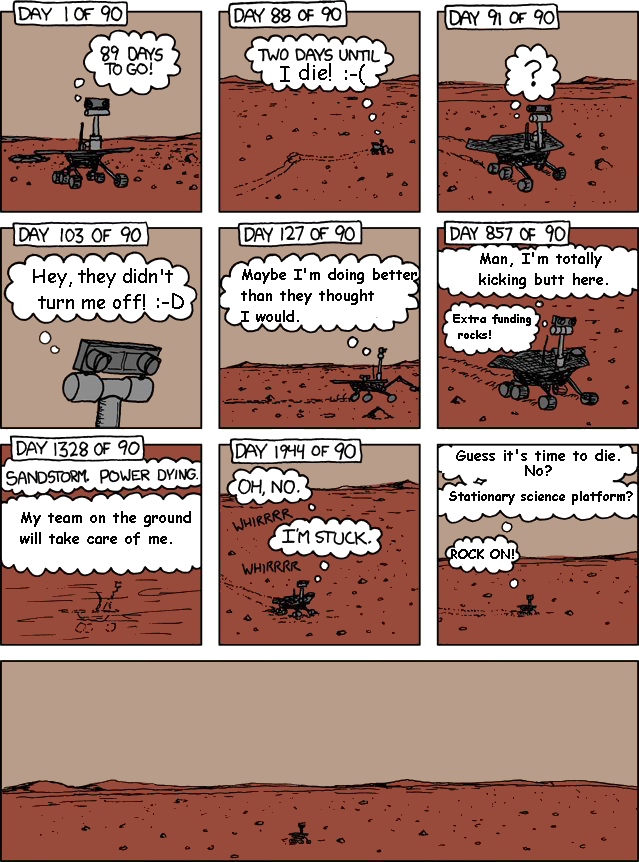
If anyone is still sad about my Spirit comic, maybe this person’s rewrite – author unknown, found on a random image page – might provide some comfort. Also, I got a couple of nice letters from members of the Spirit/Opportunity teams, and it’s very clear how proud they are of these little rovers. Next, Europa!
This entry was posted on Monday, February 8th, 2010 at 1:12 pm and is filed under Uncategorized. You can follow any responses to this entry through the RSS 2.0 feed. You can leave a response, or trackback from your own site.
These optional house rules may make Monopoly a whole new game for you. Please let me know if you have played any good home rules that I have not mentioned, or if you play with any of these rules tell me what you thought of them. I mark the ones I recommend.
Increase movement options:
Dice Choice
Rule: A player must roll two dice on his turn, but may select any two dice from a set of four sided, six sided, eight sided, and ten sided dice.
Reason: Gives players some control over movement. Players may wish to role two four sided dice at the beginning, since they have a better chance of getting doubles and going again, and then later roll two ten sided dice to move around the board quickly. Larger dice decrease the chance for doubles and thus tend to balance the game.Dice Control
Rule: A player may choose to roll only one die on his or her turn rather than two. If the player rolls a one, he or she must go directly to jail for making an “impossible” movement.
Variations: A player may announce before making a roll of two dice that he or she is going to move the product of the dice rather than the sum. If the player then rolls higher than twenty, the player is sent to jail for “speeding”, and as above if the player rolls a one, he or she must go directly to jail for making an “impossible” movement.
Reason: Gives players some control over movement. This rule is probably only a good idea if Maximum Punishment is in effect, otherwise players may use this rule to get into jail quickly.Traveling Railroads recommended
Rule: Whenever a player lands on a railroad, the player may choose to move his or her token to any other railroad owned by the same player.
Clarifications: The player must pay rent even if he or she does not travel. A player may travel on his or her own railroads, for free of course. A player may not travel on unowned railroads. Travel is across the board, so a player does not get $200 for passing Go when he or she travels from Short Line to Reading Railroad. The owner of the railroads may not prevent the player from traveling. A player may travel to or from a mortgaged railroad.
Variations: The owner may disallow a player from traveling on his or her railroads if the owner refuses to take the rent from the player landing on it. The owner must decide to disallow travel before the player is required to specify his or her destination, if any. The owner must allow travel from a mortgaged railroad.
Reason: Gives players control over their tokens, and makes the ownership of the railroads important. For example, The player developing the green properties should attempt to split up the railroads so that players landing on them do not always travel to Short Line and thus skip the green group. On the other hand, the player developing the dark blue group should encourage a railroad monopoly, since so many players move to Short Line to get closer to go and are more likely to land on the dark blue group.Increase development options:
Double Hotels
Rule: Players may build up to two hotels on a property. Rent must be paid on all buildings on a property.
Clarifications: After a player has raised a hotel on a property, he or she may purchase up to four more houses on that property and then may purchase a second hotel for that property. A player may not have more than four houses on a property.
Example: If a player has a hotel and two houses on Park Place and a hotel and three houses on Boardwalk, the rent is $2000 on Park Place and $3400 on Boardwalk.
Reason: Gives players more building options. Players may also more easily create a building shortage.Free Market
Rule: Players may build houses on any property they own, even if they do not have a complete set. If a player lands on a property which has been improved, they can either pay what they owner asks, up to a maximum of the normal amount required, or they may instead pay rent to any other owner of one of the other properties in the group, paying whatever rent that owner requests. If the player chooses to pay a different owner, including his or her own property in the group, then the player also moves his or her token to that property.
Clarifications: A player may not switch to a different property in the group if the property is not improved, nor may he or she switch to a property owned by the bank. If a player owns all of the properties in a group, he or she can charge the maximum rent allowed, and the player landing on his or her properties may not switch to a different property in the same group. When a player owns two properties in a three-property group, he or she must improve those two properties evenly. If a player acquires all the properties in a group, he or she must rectify the number of houses on each property so that the number of houses meet the even building rule.
Example: George owns Illinois and Kentucky Avenues, and Samantha owns Indiana Avenue. George decides to build three houses on each property, and Samantha decides to build just two on Indiana Avenue. Along comes Fred, who lands on Illinois. George asks him to pay the normal $750 rent for three houses. Naturally, he decides to switch his token to Samantha to pay her the $250 she is charging. George doesn’t want to lose money that he hoped would be his, so he offers to allow Fred to stay on Illinois for only $200. Samantha drops her rent to $200 as well, and points out that George is winning already and should not be given more money. Fred can accept either offer.
Reason: Makes the reason for owning a monopoly a much more clear goal.Instant Hotels
Rule: A player may purchase hotels for one of his or her monopolies at the cost of five houses, less any houses already owned, even if there are not enough houses for each property on the group to own four.
Reason: A housing shortage only hurts players who have little money. Players with a lot of money can go straight to hotels.Partnerships
Rule: Two or more players may agree to form a partnership with a property group in which they have a monopoly between them. Each partner may then purchase houses or hotels for the property they own as long as they follow rules for building evenly. A player may leave the partnership between dice rolls, forcing all players in the partnership to sell all of their buildings.
Example: Peter owns Boardwalk and Sarah owns Park Place. They agree to form a dark blues partnership and Peter builds a house on Boardwalk. Sarah later builds two houses on Park Place so Peter builds another two houses on Boardwalk. Players who land on Park Place are forced to pay $500 to Sarah and players who land on Boardwalk must pay $1400 rent to Peter. Sarah later lands on Board Walk and pays Peter $1400 in rent. In disgust she dissolves the partnership and sells her two houses on Park Place for $200. Peter must sell his three houses for $300.
Reason: Gives more options to players.Six Railroads recommended
Rule: The two utilities are treated like additional railroads. They cost $200 to buy and can be mortgaged for $100. The rent for five railroads is $300 and for six railroads is $400.
Reason: Makes the utilities actually worth having and a railroad tycoon a serious opponent.Uneven Building recommended
Rule: Once a monopoly is gained, the owner is allowed to build houses or hotels on the monopoly in any way he chooses.
Example: A player who owns both dark blue properties may purchase a hotel and place it on Boardwalk with no building on Park Place.
Reason: Allows players latitude to build as they choose and hope for a high rent gain without having to pay to improve the entire monopoly.Non-Monopoly Building recommended
Rule: You may build houses on properties for which you do not own all the properties of a set, but the houses cost double their normal price. If you sell them back to the bank, you still only get half of their normal cost.
Reason: Allows players to still build on properties without gaining the entire set, but at a cost.Unlimited Housing
Rule: There is no limit to the number of houses and hotels in the game.
Reason: Removes the possibility of a housing shortage, and allows players who have had difficulty getting together a monopoly until later in the game a chance to improve their properties.Flexible negotiations:
Immunity recommended
Rule: A player may grant full or partial immunity from paying rent on one or more of his or her properties as part of negotiations. The details of the immunity are up to the players involved in the trade.
Clarifications: Immunity does not transfer with the property if it is traded. A player who has granted immunity to another player and then trades the property away and then later trades to get it back still must honor the original immunity given.
Example: In a six player game, George owns three railroads and Illinois, and Lisa owns the fourth railroad and the other two red properties. Lisa agrees to give the fourth railroad to George and allow him two free visits on the red group whenever he chooses. In exchange, George gives Lisa Illinois and immunity from paying rent on his railroads for the entire game. Later in the game, although George has been collecting $200 from the other four players fairly frequently, and used his free visits to avoid paying rent on Kentucky with three houses and later Illinois with a hotel, he is bankrupted from landing on Edgar’s New York Avenue hotel. Edgar thus acquires the railroads and Lisa must now pay rent to Edgar’s railroads when she lands on them.
Reason: Gives more options when negotiating trades.Loans recommended
Rule: A player may loan another player money or property at any agreed upon rate or with any agreed upon provisions.
Reason: Removes a restriction imposed by the original rules.Profit Sharing recommended
Rule: Two or more players may agree to split the rent from a property or set of properties.
Clarifications: Like Immunity, Profit Sharing does not transfer with the property if it is traded. A player who has granted profit sharing to another player and then trades the property away and then later trades to get it back still must honor the original profit sharing plan.
Example: In a six player game, Norman owns two railroads and Gary owns two railroads. Norman agrees to sell his two railroads to Gary for $400 and Gary promises to give Norman $100 of each $200 he collects in rent from the railroads.
Reason: Gives more options when negotiating trades.Balance the game:
Bank Repossession recommended
Rule: When a player is bankrupted by debts to another player, the debtor must mortgage all his or her properties, pay the creditor as much as possible, and then return all of the debtor’s properties to the bank. These properties are then available for purchase by other players as usual.
Clarifications: As with the normal rules, the debtor may not sell or trade any of his or her properties unless it gives enough money to pay the debt. The original rules also state that property acquired by the bank due to a player becoming bankrupted must be auctioned off immediately, but in this rule, this auction does not occur, and players must land on the properties in question to be able to purchase them.
Reason: Often when one player is winning and they bankrupt another player, that player gains enough property and money to insure winning the game. This rule makes the end of the game have all of the interest of the beginning, since a bankruptcy floods the board with new properties to be purchased.Double Prices recommended
Rule: All property costs twice the face value.
Clarifications: Mortgage values remain the same, as do all other values.
Variations: If the player landing on the property does not end up buying it, he or she gets a “finder’s fee” of %10 of the sale cost.
Reason: Property is too inexpensive. In the normal game, it is always a good strategy to purchase property because even if it is not part of a monopoly that one owns, it can be traded for something more useful or mortgaged if not. As a result of this rule, players usually put property up for auction unless they really want it. This rule makes the game much more challenging, since players actually must think about what they are willing to buy and when to start an auction.Maximum Punishment recommended
Rule: A player in Jail may not collect rent, buy buildings, participate in any auctions, or mortgage property. He or she may only make trades with another player in Jail or any player at Just Visiting.
Variations: A player may pay $100 immediately upon reaching jail to be placed in Just Visiting, and thus avoid a turn in jail. Good lawyers are expensive.
Reason: Makes jail a punishment rather than a safe haven.Option to Auction
Rule: Whenever a player lands on an unpurchased property, any other player can immediately start an auction for that property by bidding twice the normal purchase price.
Reason: Balances bad dice rolls by allowing players who are willing to pay extra for particular properties to have a chance at them.Initial Auction
Rule: Before the game begins, everyone writes down how much they will pay for every property on the board in a closed auction. This can be done independently, before even gathering to play. The game then begins by checking everyone’s bids and selling the properties to the highest bidder for each property, with ties broken by die roll. In this variation, start the game with more money: $10,000 divided by the number of players should be about right.
Reason: This makes the purchase of property much more interesting, removing the luck element and moving the beginning of the game along much faster, ending up quickly in the property negotiations and house purchasing. As a result, the entire game is about interesting choices, not about waiting for players to get lucky or unlucky with property purchases.Tax Man
Rule: The bank gets a token known at the “tax man” and a player will roll the dice for the bank on it’s turn. If it lands on any owned property, the owner pays the bank the amount that would normally be charged in rent. The tax man ignores the normal meaning of any other square, including “Go to Jail”.
Reason: Balances the benefit of a property that often gets landed on due to it’s placement on the board.Facilitate the game:
Honest Game recommended
Rule: Players must always pay rent, even if the owner does not ask.
Reason: Removes the annoying requirement of constantly have to watch where other players land. Also allows a game to be more social as players can trust each other to pay rent when required.Closed Auction recommended
Rule: All auctions are done by players writing down a bid and then showing in unison.
Reason: Open auctions with players yelling out bids is chaotic and tedious.Minimum Bid
Rule: Any new bid in an open auction must be at least $10 more than the previous bid.
Reason: Cuts down on tedious $1 raise auctions.Sudden Death
Rule: Before the game begins, one player is secretly and randomly determined to be the “Angel of Death”. This can be done by having one slip of paper put into a hat for each player, with a star on one of them, and then each player draws a slip. The Angel of Death player has the option, once the game has been played for two hours, of smashing the board and declaring the game over without any winner. The Angel of Death may only do so if he or she is still in the game.
Reason: The game moves much faster as players fight against time, and may end before it really drags out.Allow many players:
Double Board
Rule: Two boards, such as a standard board and an English board, have either Free Parking or Go overlapping. Players go around both boards in a figure eight pattern. When a player lands on the overlapping space, he or she may choose which board to enter next. When a player is sent to jail, he or she is sent to the jail on the board that they were occupying before going to jail.
Clarifications: A player advancing to a named property as per instructions on a card may pass Go twice, collecting $400.
Variations: Cards which affect all players or all properties, such as “pay all players $50″ or “building repairs”, only affect the properties and the players on the same board as the affected player.
Reason: Useful for games with more than five players to allow for more possible monopolies.First to Go
Rule: Players may not purchase properties until one player has passed Go.
Reason: In games with lots of players, going first gives a great advantage toward acquiring property, and going last is a major hinderance. If players can not start to purchase property until they are spread around the board, then this disparity is smaller.Order Auction
Rule: Before the game begins, players bid for the right to go first. The order of play is based upon the amount of money bid.
Reason: In games with lots of players, going first gives a great advantage toward acquiring property, and going last is a major hinderance. By paying for the privilege, the games is more fair.Start at Corners recommended
Rule: Players put their tokens at the four corners of the board rather than Go as their starting positions. The player on “Go to Jail” does not. Players should be spread evenly to all the corners, and which player starts at which corner should be determined randomly.
Reason: By starting in different locations, the players are less likely to land on properties already owned by players who went before them.Increase money supply:
Bank Loans
Rule: a player without an outstanding loan may at any time take out a $500 loan from the bank. Every time the player passes Go he or she only receives $100, the other $100 remaining in the bank as interest. The loan may be repaid any time after the player has passed Go and given the bank interest at least once.
Clarifications: If a player bankrupts the debtor, he or she inherits that debt, unless the “Bank Repossession” rule is used, in which case the bank dissolves the debt.
Reason: Gives players more monetary options.Double Salary
Rule: A player who lands on Go gets $400 rather than $200.
Clarifications: Players who pass Go only get the usual $200.
Reason: Puts more money into the game to make it easier.Free Parking Jackpot
Rule: $500 is placed in the middle of the board at the start of the game. Any time a player must pay a fine or tax the money also is put in the middle of the board. Whenever a player lands on Free Parking, he or she gets the money in the middle.
Clarifications: The $500 is not replaced after the jackpot is first taken. It is only for the first lucky player to land there.
Variations: Play without the $500 jackpot, or with only $50 which is replaced every time a player lands there. Some players only put Luxury Tax money there. Note: This is the most common home rule that people play, and there are lots of variations on it. Some have more money, some have less, but there are so many ways it is done, I can’t list them all.
Reason: Throws another variable into the game and gives a losing player a chance to get back into the game, or at least a dim hope.Miscellaneous:
Doubling Up
Rule: Only one token may be on a square at a time, except on Go and Jail. When a player’s token lands on a space already occupied by another player, the player moves his or her token backwards to Go and his or her turn is over. No money is collected for moving backwards to Go.
Reason: Has the effect of lowering the amount of money in the game because players pass Go less often, and the lower valued properties are landed on more frequently.Foreclosure
Rule: When a player lands on a mortgaged property, the owner may immediately unmortgage the property by paying the mortgage value plus %10 interest. If the owner does not do this, the player may purchase it by paying the player the mortgage value and the bank the mortgage value plus the %10 interest. Either way the player still pays no rent.
Reason: Makes mortgaging property more difficult and more dangerous.No Mortgaging recommended
Rule: You cannot mortgage property. You are allowed to sell property back for half the printed purchase price.
Reason: Mortgaged property makes the game much less interesting. By removing that option from players, they must make hard decisions. Further, interesting properties may reappear on the board for sale. Often players may decide to have their own auction for a property instead of selling it back to the bank.Optional Draw
Rule: When a player lands on Chance or Community Chest, drawing a card is optional.
Reason: Gives more options and control.Two Tokens
Rule: Each player has two tokens, and alternates which token is moved each turn.
Reason: In a two player game, this means that both players have tokens covering more space on the board. This is particularly interesting when making house buying decisions, because one of your opponent’s tokens may have passed your monopoly, but the other may be coming up to it, thus a house purchase may be a good idea. With just one token, you know how far the opponent is from your monopoly, and the decisions are not as interesting.